Optimization of manufacturability and compression strength for open-cell plates lattices
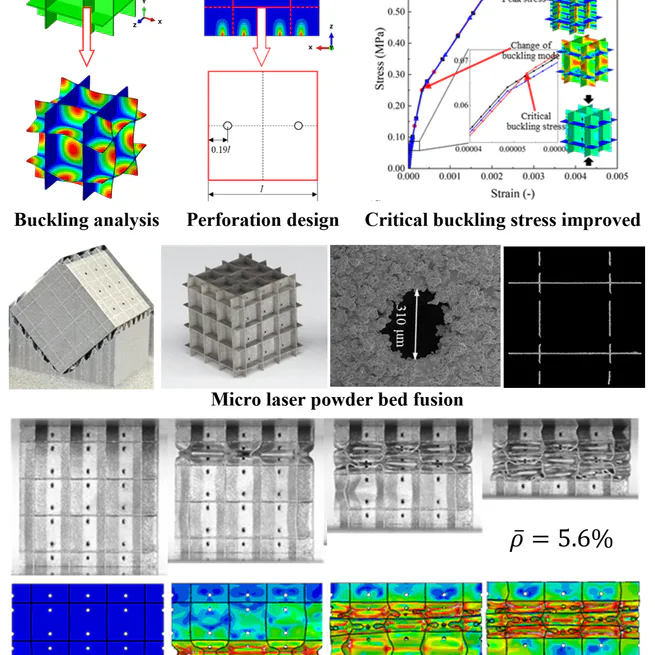
In this project, we developed and validated a novel design methodology to enhance the manufacturability and buckling strength of metallic plate lattices. The core challenge was to introduce micro-holes for powder removal in additive manufacturing without the typical reduction in mechanical performance, particularly against buckling failure in low-density structures. Theoretical & Numerical Method Development: ⦁ We established a design framework rooted in a Rayleigh quotient-based theoretical criterion to identify the optimal locations for micro-holes that actively increase the critical buckling load of a plate. ⦁ To implement this, we developed a robust numerical method to evaluate the second-order derivatives of the buckling eigenmode. This was achieved by directly utilizing the shape functions of 8-node second-order shell elements (S8R) within Abaqus. Finite Element Analysis & Design Optimization: ⦁ We applied this methodology to design optimized Simple Cubic (SC), Body-Centered Cubic (BCC), and Face-Centered Cubic (FCC) perforated plate lattices. ⦁ Using Abaqus/Standard and Abaqus/Explicit, we performed a comprehensive suite of simulations, including linear eigenvalue buckling on Representative Volume Element (RVE) models with periodic boundary conditions, nonlinear post-buckling analysis incorporating geometric and material nonlinearities, and large-deformation compression simulations on full-scale models. ⦁ Our analysis successfully demonstrated that the optimized designs increased critical buckling stress by up to 15.1% compared to unperforated lattices, while maintaining comparable post-buckling compressive strength. Experimental Validation & Characterization: (by our collaborators) ⦁ We fabricated the optimized lattice specimens using μ-LPBF with SS316L powder. ⦁ Through quasi-static compression testing, we experimentally verified that the fabricated lattices exhibit superior mechanical properties. Publications related to this project: 10.1016/j.matdes.2024.113544
Sep 1, 2022
Optimization of buckling strength for truss lattice with freeform cross-sections
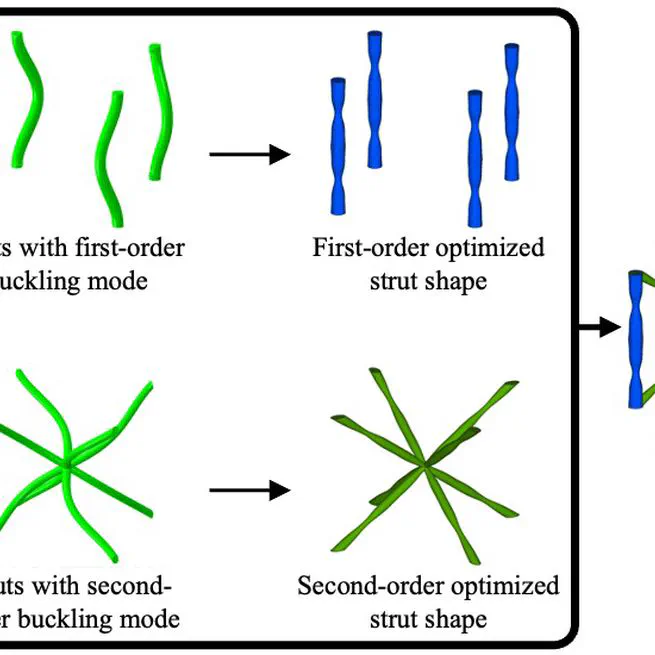
This project focuses on analysis and optimization of thin struts in lattice core sandwich panels. Lightweight lattice cores are easy to fail by buckling due to its long slenderness ratio. We optimized thin struts in lattice core sandwich structures to improve buckling resistance. The key innovation was an efficient, bottom-up methodology that avoids computationally expensive optimizations on entire structures. Methodology & Strut Optimization We developed an efficient, bottom-up design methodology to improve the buckling strength of lattice core sandwich structures. The strategy involved first identifying the optimal, non-uniform cross-sections of individual struts by maximizing their buckling eigenvalues using a Python-Abaqus scripted workflow. Strut profiles were modeled with a Fourier Series (FS) representation, and a key finding was that the optimal shapes are proportionally scalable, creating a reusable library of high-performance struts. Lattice Design & Simulation We designed four distinct non-uniform lattice cores (Kagome, BCC, BCCZ, and Six-fold) by strategically replacing uniform struts with pre-optimized shapes based on their specific, identified buckling modes (first or second-order). Comprehensive eigenvalue and nonlinear post-buckling (Riks method) analyses in Abaqus confirmed these designs achieved a 16-21% improvement in critical buckling load over uniform counterparts. Experimental Validation We validated the designs by fabricating BCC and Six-fold specimens from Nylon 12 powder using Selective Laser Sintering (SLS). Quasi-static compression tests demonstrated a measured compressive strength improvement of 18.77% for the BCC structure and 10.00% for the Six-fold. We also developed a high-fidelity nonlinear FE model that incorporated material plasticity and a measured 80µm surface roughness layer, achieving excellent agreement with experimental peak loads and failure mechanisms. Publications related to this project: 10.1080/0305215X.2022.2163239
Sep 1, 2021