Achieving Sub-pixel Level Feature Size for Projection Stereolithography via Precise Spatial and Temporal Control of Photopolymerization
Aug 13, 2025·,·
1 min read
Mingpei Cang
Huachen Cui
Abstract
During projection stereolithography, the diffusion of reaction agents and Gaussian pixel radiance make it challenging to 3D print features close to the nominal optical resolution. A multi-factor model that precisely predicts the photopolymerization process in temporal and spatial domain remain elusive. Here, we developed a reaction-diffusion model involving the effects of Gaussian pixel radiance, nanoparticle scattering, and radical diffusion to predict as well as visualize the reaction with sub-pixel level spatial resolution. Based on this model, we developed a novel grayscale compensation and segmentation exposure strategy, which, for the first time, enabled the fabrication of negative features of 0.8 pixel-size and positive features of 0.2 pixel-size. We also found it possible to achieve continuous production of parts with mere baseline top-down printing system, eliminating layer artifacts without the need of oxygen permeable membrane, nonreactive fluid bed or acoustic air-volume modulation. Our method successfully fabricates assembly-free planetary gears and microchannels.
Date
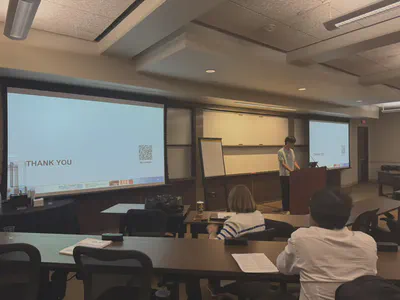
Aug 13, 2025 4:30 PM — 4:50 PM
Event
Location
AT&T Hotel and Conference Center, Austin, TX, USA
Austin, TX